

Local communities seem like a natural pairing for local energy. Communities run essential services that can’t afford power outages. Microgrids spare them the problem.
But as much as communities might want to pursue microgrid development — not only to ensure electric reliability but also to gain control of their energy supply — many feel they lack the expertise and resources to undertake it. Community microgrids represent an estimated 9% of projects worldwide, dwarfed by commercial and industrial, military, and utility microgrids.
For more than a decade, Montgomery County, Maryland, has been an exception. It’s built several microgrids and has many more planned.
Much has already been written about Montgomery County’s microgrid program, but I wanted to dig deeper. How exactly did they pull this off when so many other municipal governments find it difficult?
So I spoke to Michael Yambrach, chief of Montgomery County’s Office of Energy and Sustainability and Khaled Fakhuri, senior vice president of Schneider Electric’s Microgrid Business, the county’s long-term development partner.
If you want to listen to the full conversation, click on the podcast below. (It was interesting!) For a shorter version, keep reading.
Listen to our podcast before they go public by joining our Substack
Is it about access to money?
I honestly used to think that Montgomery County’s success was due to its wealth. Located just outside Washington, DC, the county’s population ranks in the top 1-2% nationally in terms of household income.
It turns out, though, that household income doesn’t mean there is a bounty of government funds for microgrids.
“It seems as though we might be a wealthy county, but we’ve got no money. Government agencies are always tight,” Yambrach said.
There are plenty of other projects always competing for funds.
And while the wealthy might contribute money to get their names on a library or rec center, “I don’t know of anybody that’s ever gotten their name put on a power generation system,” he said.
That leaves Montgomery County’s energy development programs vying for limited government funds at a time when federal contributions have grown increasingly scarce under the Trump administration. That hasn’t derailed Montgomery County’s aggressive energy resilience plans, but it has slowed them down.
“The biggest impact to us is not whether we’re going to move forward, but when,” Yambrach said.
Spurred by a 2012 derecho that caused widespread power outages, Montgomery County has built a portfolio of microgrids that serve its public safety headquarters, correctional facility, an animal shelter, recreational center, and transit depots. Next, it plans to create dozens of community resilience hubs.
Fakhuri’s read of the broader market where Schneider Electric plays is similar. Federal incentives accelerate deployment, but they don’t alter the fundamental drivers: aging infrastructure, rising electricity costs, and demand growth that the grid is struggling to absorb. “Access to public funding can accelerate things for sure, but it doesn’t change the fundamentals,” he says. Battery costs are coming down. The technology is becoming more modular and faster to deploy. The need is not going away.
Tried and true strategies
Not everything Montgomery County does is unique. It’s managed its microgrid development the way many do now, by tapping into low- or no-downpayment financial models, such as energy-as-a-service contracts, where the host pays for the energy over time with costs generally at least partially offset by savings the new energy system achieves. This model offers special appeal to local governments because the developer generally assumes much of the project’s operational risk.
“Most organizations I know don’t really have staff capable of running these types of systems — they’re not in the power generation business, they’re not relating to utility companies, or looking at supply-demand scenarios,” Yambrach said.
What’s unique about Montgomery County
But the county’s success relies on some unique strategies too, which are part institutional, part personal and part forward-looking.
It starts with how the county is organized—and how it thinks about risk.
For one, it doesn’t treat microgrids as one-off pilot projects, as so many communities do. Instead, it incorporates them into long-term planning for essential infrastructure.
“We have an Office of Energy and Sustainability that can actually operate a little independently from the normal type of procurement development process that most other government agencies operate in,” Yambrach said. “We have the ability to do things differently than going through our normal procurement process.”
That independence matters. It allows the county, which has just over a million people, to move faster and evaluate projects differently than traditional facilities departments.
The ability to move faster has been the foundational, as has the embedded expertise Yambrach brings. He has worked in the microgrid arena since 1985. By the time he arrived in Montgomery County in 2014, he had years of microgrid development behind him, which meant he could look at the public safety headquarters — a facility sitting at the end of a deteriorating distribution line, housing operations for the Department of Transportation, Homeland Security, fire, and police — and immediately see it as a microgrid problem.
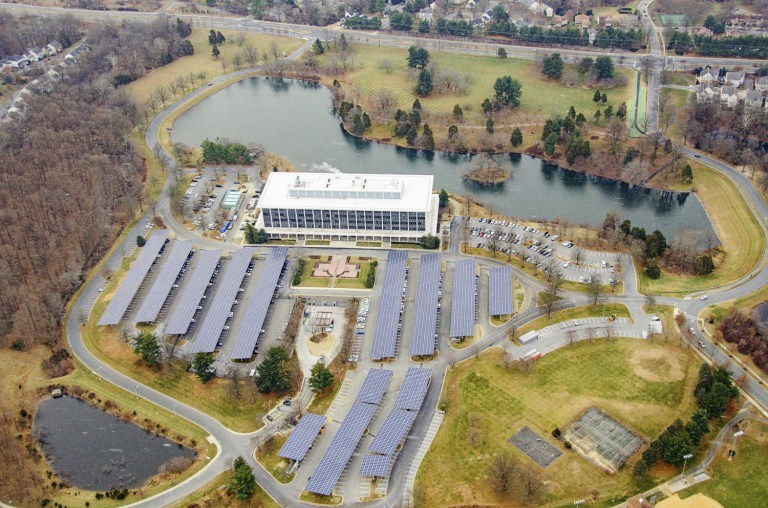
“When the grid goes down, this is the facility that helps clear the roads and gets the streets back and operating so that the local utility company, Pepco [the local utility], can go out and actually clear the lines,” he said. That first project, completed in 2018 alongside the county’s correctional facility, became the template for everything that followed.
Thinking bigger picture
The county realized that sustainability and resilience aren’t just about buildings, but also about moving the population around.
So its next wave of microgrids grew directly from its decision to electrify its transit fleet. Electric buses don’t run on diesel reserves — they need power. And that meant the county had to think hard about what would happen to its bus operations when the grid went down.
“The only way we could really secure the ability to keep these buses running is to start generating our own power,” Yambrach said.
The result is the Brookville Depot, an all-electric microgrid facility. A second depot — due to come online within the year — will add hydrogen to the mix. And hydrogen is where the county’s ambitions get genuinely unusual — and forward-thinking.
Because green hydrogen is hard to obtain, Montgomery County has decided to produce its own.
It plans to pair nearly 5 MW of solar with an electrolyzer to produce hydrogen for transit buses — and eventually for generators. The long-term goal is to replace natural gas across its microgrid portfolio.
“It’s a lofty goal, and it’s going to take time. And it’s not cheap,” he said.
The goal is to power 30% to 50% of the transit fleet — specifically the longer bus routes that battery-electric vehicles can’t yet match — with hydrogen produced entirely from renewable energy.
The longer ambition is to eventually replace the natural gas generators currently supporting the county’s microgrids with hydrogen-fueled generators — making the entire system as close to carbon-free as current technology allows.
The county has a hard regulatory deadline: 100% renewable by 2035. Yambrach is frank that not every interim milestone will be met on schedule, but the direction is fixed.
Montgomery County’s formula
- Institutional structure matters.
- Start with the facilities that can’t afford to go dark.
- Choose long-term partners, not vendors.
- Think transportation, not just buildings.
- Build at scale when you can.
- Take control of supply where you can.
- Be clear about value.
Going for scale
With the transit depots underway, Montgomery County has set its sights on the most geographically ambitious phase yet: 23 smaller microgrid systems at police stations, rec centers and fire stations spread across the county. The goal is to create a network of community refuges that stays lit when the broader grid goes dark.
“In a major emergency where the power grid goes down, people can come and shelter in place,” Yambrach says. “If it’s during the summer, they can go to a cooler spot; if it’s in the winter, there’s heating. They can charge their cell phones and contact relatives.”
The 23-site scope is deliberate. Doing that many projects together creates economies of scale — on equipment, on installation, and critically, on the operations and maintenance contracts that the county outsources to third parties. Standardizing components across a fleet of facilities makes O&M manageable and keeps long-term costs from spiraling.
Beyond storms: the rising value of community microgrids
That said, Yambrach doesn’t sugarcoat the economics. “I don’t want to dismay anybody, but a lot of these systems have no cost savings — they’re expensive.” The value isn’t in the energy bill. It’s in doing what local government is supposed to do: keep buses running, keep emergency facilities operational, keep communities together when the grid fails.
Quantifying that value isn’t always easy.
“Working with governments, it’s hard to figure out what the value is of a rec center not being able to stay open, or what happens if half of your bus fleet is not operating.” Unlike a hospital or data center, where downtime has a clear dollar figure, the costs of lost public services ripple through communities in ways that don’t show up cleanly on a spreadsheet.”
At the same time, the need for energy resilience is becoming more apparent. It’s no longer just about storm outages. With the rise of data centers, mounting load growth, and rising electricity costs, the grid itself is under strain — pushing more communities to consider controlling at least part of their own supply.
“The conversation is definitely shifting from can microgrids work to how fast can we deploy them and finance them, and to what level of scale can they be the right solution?” said Schneider Electric’s Fakhuri.
That shift reframes Montgomery County’s story.
For years, it has been held up as a forward-leaning outlier — a wealthy county doing something others couldn’t. But its real advantage wasn’t money. It was deciding early that resilience is infrastructure, not a pilot project, and building accordingly.
That’s what makes its approach newly relevant.
As the grid grows more constrained, more communities will face the same question Montgomery County answered a decade ago: not whether microgrids make sense on paper, but whether they’re willing to plan for what happens when the grid fails.
Montgomery County chose to act.
Now others may not have the luxury of waiting.