
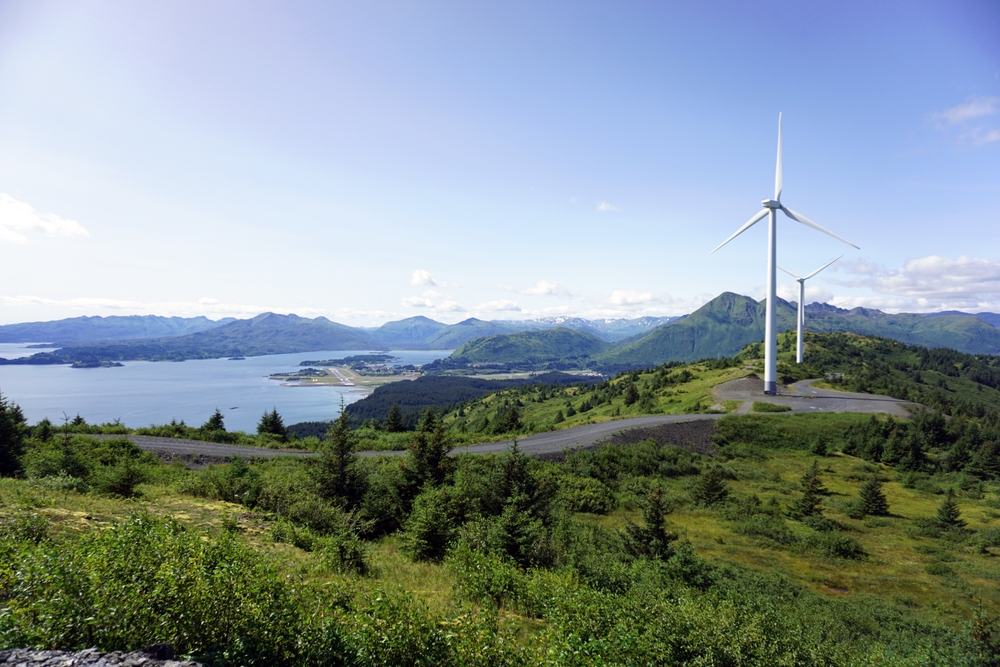
Microgrids are a hot topic these days, largely because large data centers need power and long queues make traditional utility service difficult to obtain. The Trump administration’s deep cuts in federal incentives for renewables have put the spotlight on the inherent value of distributed energy resources (DERs) in general, but also on fuel-free assets whose cost is not impacted by geopolitical factors beyond our nation’s borders. While most microgrids deployed in the continental U.S. have not been deployed by utilities, one state is different: Alaska.
In the world of energy, Alaska has long been associated with the discovery of first oil, and then later natural gas, resources that provided tremendous economic benefits but were primarily viewed as an export opportunity, not a solution to local needs. The high cost of fossil fuels – particularly diesel – and the growing specter of global climate change, whose impacts are palpable throughout the Arctic as glaciers melt and treasured species of fish such as salmon and crab decline, triggered a small energy revolution in the 49th state.
Microgrids have sprung up here not because of regulatory fiat but because of economic necessity. Alaska’s electricity costs are among the highest in the nation.
Many remote communities in Alaska ironically started with renewable energy systems. Places such as Cordova, a fishing port at the mouth of the Copper River – much of Costco’s wild salmon comes from here — unconnected to any roads and often blasted by wind and rain, is one of the most innovative utilities in the world. Its history encapsulates the roller-coaster nature of energy system evolution in Alaska. The utility started as 100% hydro, then shifted to 100% diesel, and now operates as a hybrid hydro-diesel system that uses modern lithium-ion batteries to limit fossil fuel combustion and balance this small, fragile grid in unprecedented ways. Recently, the utility deployed a micro-data center inside the walls of the utility control room, which runs on 100% renewable energy, a model with major ramifications for regions of the world where a large data center would never make logistical or economic sense.
Bottom Up Solutions
The story of Cordova’s microgrid is just one inspirational story included in a forthcoming University of Alaska Press book entitled Alaska’s Microgrid Innovators: How Communities Are Responding to Today’s Energy Challenges. I served as the volume editor and conceptualized the book, helping guide and shape most chapters, most of which are first-person accounts from across the stakeholder spectrum: utilities, academics, native peoples, entrepreneurs, non-profit public policy advocates, and other industry participants. The central core of the book will trace specific community-led microgrid ventures not only in Cordova, but places such as Kodiak Island – home to a virtual 100% renewable energy microgrid serving the second largest island in the U.S. – as well as Kotzebue, an early wind turbine pioneer now also integrating solar energy into its remote microgrid resource mix.
Alaska’s innovation to date has been fostered by 100 utilities serving less than 800,000 people. A few utilities serve less than 100 people. Some large private utilities in the continental U.S. serve more accounts than all of Alaska. This decentralized approach has fostered innovation out of necessity, not government mandate. Renewables simply make economic sense.
Is It Time for Top-Down Public Policy Intervention?
Today’s climate crisis is stimulating a debate in Alaska about the next chapter in the state’s fascinating energy history. Can the state build upon its past innovation, which was driven largely by local decision-making often married to federal and state government grants, and take the next step traveling down a decarbonization path?
Ironically, it is the Railbelt Grid, the only major transmission system in the state, which lags behind the remote communities referenced above in terms of renewable energy adoption. The so-called Railbelt utilities have not yet embraced the types of market reforms that are revolutionizing relationships between utilities and their customers in the rest of the U.S. and other parts of the world such as Australia, Japan and Europe.
The good news is that the Alaska Center for Energy and Power, housed at the University of Alaska-Fairbanks, explored different pathways to decarbonize for the Railbelt, which was summarized in this white paper. Everything from new modular nuclear reactors to large-scale hydrogen production – as well as unprecedented tidal power development scenarios – are being modeled and examined. If Alaska wants to continue to make progress in reducing its collective carbon footprint, the Railbelt Grid, which serves two of Alaska’s biggest cities (Anchorage and Fairbanks), will need to be part of the solution. It can no longer afford to be a laggard.
While much of this book celebrates the virtues of bottoms-up and decentralized remote microgrids — each carving their own playbook to reduce costs and emissions at the same time — the severity of the climate crisis requires a new approach. Such is the perspective of Chris Rose, the recently retired executive director of the Renewable Energy Alaska Project (REAP) which has been championing public policy changes for years, often to no avail. Whether it is common policy tools such as a renewable portfolio standard (RPS) for the Railbelt, or market reforms now common throughout the U.S. and other industrialized energy markets (such as creation of an independent transmission system operator), one could make a solid argument that Alaska now needs to up its game and intervene into its electricity markets in order to improve efficiency, lower costs and simultaneously shrink the state’s electricity production carbon footprints.
My Own Concluding Words
The book concludes with my own comparative analysis of Alaska with the rest of the world, and which lays out what Alaska needs to do to continue innovating. The current Trump administration is making that leap into the future more difficult. One of my primary arguments articulated in the book is that Alaska needs to move away from a grants-based approach to renewables, and the current administration’s efforts to derail renewables after the book manuscript was largely completed certainly underscored the wisdom of this observation.
Alaskans can celebrate their successes which are for the first time chronicled collectively in this book, knowing that the next step on its decarbonization journey will require not only bottoms up ingenuity, but also top-down leadership. New technologies such as electric vehicles, advanced energy storage solutions, and perhaps artificial intelligence will all need to be incorporated into Alaska’s toolkit. The state’s extreme cold, on and off seasonal solar resource and subsistence lifestyle in most rural areas will pose major barriers. Large industrial-scale hydrogen production that leverages legacy oil and gas players will probably need to be married with better utilization of DERs that empower formerly passive consumers into prosumers. How to do that in a state where energy costs double the rate of the rest of U.S. and per capita consumption ranks near the top of all 50 states will clearly be a challenge. But overcoming what seems like the impossible is the Alaska way, as is revealed in the personal stories featured in this book.
Unlike other parts of the US, Alaska utilities fully embrace microgrids because they are the only viable option for electricity in rural Alaska. (In the Lower 48, many utilities still push back against microgrids in states such as where I live in California.) Alaska has yet to build on this microgrid legacy to contribute to the global energy transition in a major way, but hopefully this book will help change that.
It is rural Alaska that is pushing the envelope on new forms of load management, frequency regulation, creative thermal energy strategies, and other nuanced solutions. Perhaps rural Alaskan utilities can inspire their Railbelt counterparts. If it can work in Alaska, it can work anywhere. And new discoveries of potential solutions keep popping up, including vast hydrokinetic resources located under the ice of Alaska’s rivers that are truly astounding.
The time has come for Alaska to cull the lessons learned from communities such as Cordova, Kotzebue, Kodiak Island, Igiugig, and others and apply them across the rest of the state. An “all of the above” energy strategy should not be a cover for propping up traditional industries that are paying lip service to climate change. Rather, it should harvest the best of what has worked in the past to push forward with new policy and tools that will be necessary to create an affordable, sustainable, and vibrant future not only for Alaska but also for the rest of the world.
I like to say Alaska looks more like the rest of the world than the rest of the U.S. If true, then rural regions of the world in Africa, Asia and Latin America should surely take note of the state’s microgrid success stories.
Peter Asmus has over 35 years of experience as a reporter, analyst, consultant and book author on energy topics. Alaska’s Microgrid Innovators is his fifth book on energy and environmental issues. www.peterasmus.com