

Hat’s off to you, microgridders. 2025 was a tough year for many of you. But you’re ready to take 2026 by storm. You’ve identified new opportunities — especially for more complex projects that move beyond simple solar and storage configurations — and are pursuing them.
That’s the key takeaway from a new market survey that Energy Changemakers recently published in partnership with Xendee and Factor this Renewables.
We surveyed more than 150 microgrid and distributed energy leaders and found a bullish industry poised to capitalize on strong fundamentals: rising power demand, higher electricity prices, long delays in building centralized generation, and the continuing need for better energy reliability.
Adib Naslé, CEO of Xendee, explained why microgrids are right for this market: “With permitting delays and power outages already costing businesses real money, speed to power and cost certainty have become non-negotiable. Many companies are forced to rethink where power comes from, and now see the traditional grid as too fragile, accelerating the shift to microgrids.”
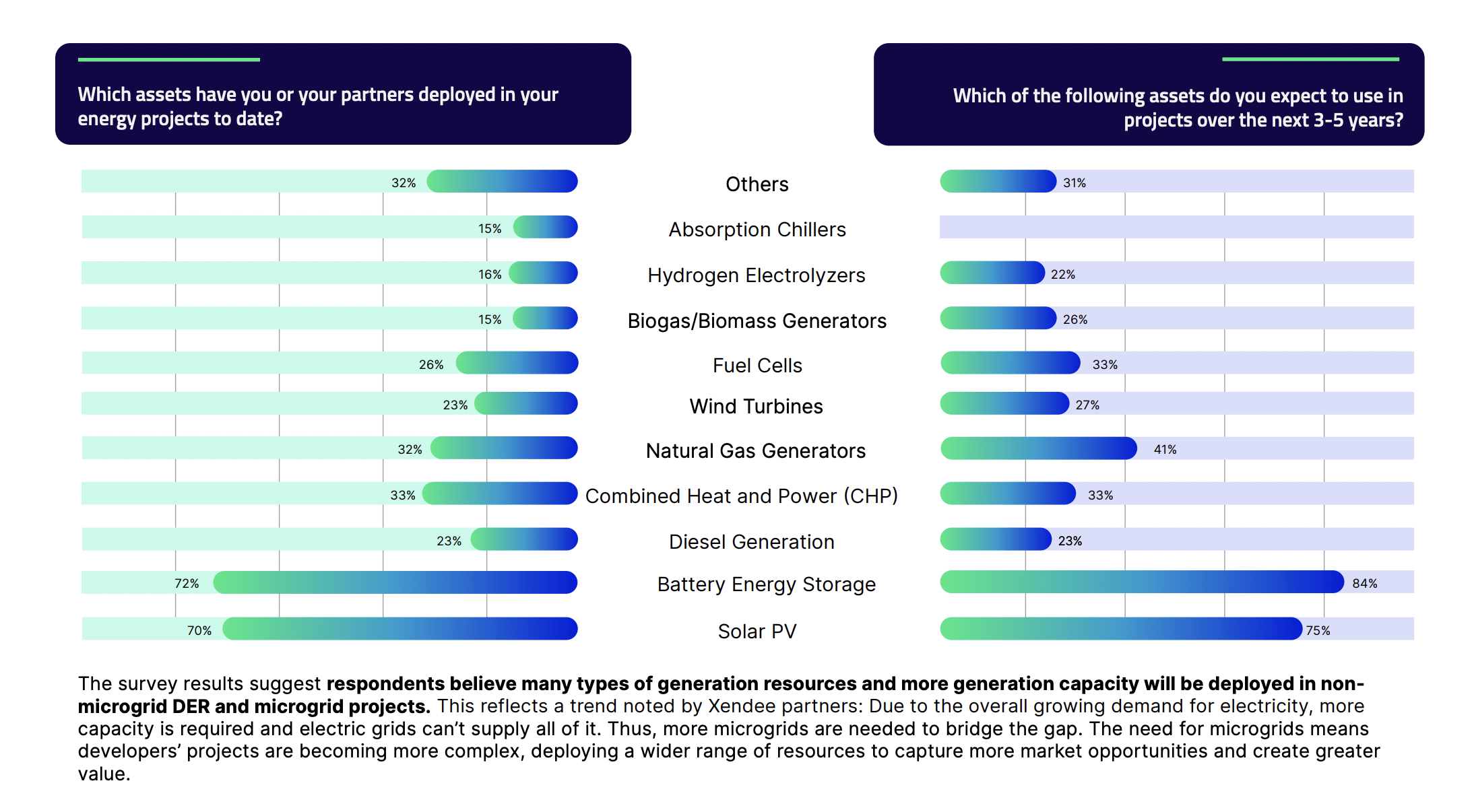
Microgrid developers are increasing project complexity as they step up to serve growing demand from data centers, advanced manufacturers and electrification. To enhance economic value for their customers, developers are deploying a broader mix of distributed energy resources.
Survey respondents said they plan to increase use of solar (+5%), battery energy storage (+12%), natural gas generators (+9%), fuel cells (+7%), wind turbines (+5%), biogas generators (+11%), and hydrogen electrolyzers (+6%).
Here’s another interesting finding. It looks like the industry is innovating its way out of the funding dilemma caused by the loss of incentives in 2025.
That’s not to say federal policy changes aren’t continuing to create challenges this year — 60% of respondents say they will, and more than two-thirds don’t see state-level grants and incentives making up the difference.
Yet 70-75% of developers did not identify funding as a top challenge in 2026. This may indicate that microgrid business models are now less dependent on the federal government.
And finally, reports of solar’s demise are greatly exaggerated. Despite last year’s rollback in federal funding, an even greater percentage of respondents expect their businesses or partners to deploy solar (75%) and battery (84%) in their projects over the next three to five years.
Those are a few of the findings, but there’s much more. Please download Xendee’s 2026 Market Survey—Microgrid and Distributed Energy Projects Grow in Complexity: Developers Pursue Value to Overcome Federal Incentive Loss.
And thank you to the many Energy Changemakers community members who participated in the survey!